Teach it one job.
Jay Margalus · jaymargalus.com/foundations · The makerspace, March 2022
| 2:45 | Where we are | 3 min |
| 2:48 | Week 1, checked: what Log 1 said | 7 min |
| 2:55 | What a skill is | 10 min |
| 3:05 | Watch me build one | 10 min |
| 3:15 | Build yours | 35 min |
| 3:50 | Demo to a classmate | 10 min |
| 4:00 | Wednesday, Friday, Log 2 | 10 min |
| 4:10 | Questions | 5 min |
Wednesday it ran.
Today it learns a job.
Week 1, checked
Hands up.
Hands up if…
- Claude Code runs on the laptop in front of you, signed in.
- Your gift is already given.
- You've talked to a real person about a tedious task since Wednesday.
- You have Co-Intelligence in your hands.
- You've turned off the permission prompts.
Item 1 is the only one that changes what happens in the next hour. Item 5 comes up in a minute.
What I read in Log 1
- Twenty of twenty. Everyone's in. Two of you sent it twice; once is enough.
- The quotes landed. "Hundreds of emails per day." "The information lives in a binder." "This work can be automated but I don't know where to start." "Every week [he] has to send my mom his travel and meeting schedule and [he] sometimes forget[s]." Those are inefficiency cards waiting to be written.
- Thirteen of you couldn't attach the screenshot. The form has no upload; that's on me, not you. Pasting what it printed counts. From now on: drop the picture in Drive, paste the share link.
- "Nothing yet" was fine. Dots and N/A are not. Five logs had fields with nothing in them. Revisions are free for 48 hours after I return them. Every week.
Two of you wrote install status under touch-point status. Touch points are the three places your harness meets the process owner's work. You don't have one yet; "none" is the answer.
Three things to fix before Wednesday
- Turn the permission prompts back on. Five of you switched them off in week one, one of you at boot. That prompt is the hand on the thing before it leaves the building. Week 3 is how to make it fire only when it matters. Until then it fires every time.
- Seven logs were under 500 words. The spec is 500 to 800. It isn't a length for its own sake: under 500 means a field got a sentence instead of what happened. Log 2 is the first one that counts toward the bundle at full weight.
- Three gift plans are purchases. Five are apps. The exercise says made or done. A gift card isn't. An app can be, if it's in their hands by Friday. Ship the small version: the one screen they'd actually use.
None of this costs anything today. All of it costs something if it's still true Wednesday.
What a skill is
A named, reusable behavior. The first piece of your harness.
A prompt is a request. A skill is a policy.
- A prompt lives in one conversation and dies with it. A skill lives in a file and comes back every time.
- A skill has a name. You call it with
/name. The agent can also reach for it on its own when the job matches. - A skill encodes a decision you made once: the format, the constraints, the questions to ask, the things to refuse.
Model: the engine. Harness: the car. A skill is the first part you bolt on.
What one looks like
.claude/skills/card/SKILL.md
---
name: card
description: Turn a messy note about tedious work
  into a five-line inefficiency card with its
  bucket and a ten-more-customers check.
---
Given this note: $ARGUMENTS

Write exactly five lines:
1. Who does this (org, role, place)
2. What the hands actually do
3. How often, and how long each time
4. How I know (saw it / they told me / guessing)
5. Bucket: process, decision, discovery, outreach

Then one line: could ten other organizations
pay to stop doing this? If not, say "errand."
Refuse any note that doesn't name the organization.- The folder name is the command.
card/means you type/card. - The description is how it gets found. The agent reads it to decide when the skill fits. Write it for a stranger.
- The body is the job. Plain English. Numbered steps. What to produce, what to refuse.
$ARGUMENTSis whatever you type after the name.
Every line in that file is a decision. Wednesday's three inefficiencies are five lines each. This is why.
Satisfactory, on a Monday
- It exists in your agent's configuration and runs without errors.
- You can say, in one sentence, what it does that a one-off prompt doesn't.
- You demoed it to a classmate before you leave. Their name goes on your log.
- It's written up in Friday's log under Harness change.
Deliverables page, № 03. Four checkpoints, Weeks 2–5: skill, hook, rule, memory. A late Monday demo costs a token.
Watch me build one
Same folder as Week 1. Your index cards are still in it. Every line in the file is a decision, like every box on this sheet.
What you just saw
| Moment | What happened | What it means |
|---|---|---|
| Bare prompt | A reasonable answer, in whatever shape it chose | Requests get answered once |
/card | Five lines, the bucket, the ten-more check, every time | The format is a decision, made once |
| Second note | It refused "a restaurant": no organization named | Constraints are a decision, made once |
| Same input, no skill | Different shape, no refusal | That's the before/after you'll show a classmate |
The one-sentence answer: a skill turns a format and a set of rules into something I never have to ask for again. Yours will have a different sentence. You need to be able to say it.
Build yours
One job. Two real inputs. One change after you see the output.
Pick one
/card
A messy note about tedious work → the five-line inefficiency card, its bucket, the ten-more check.
Use it tonight on your three for Wednesday. Refuses a note with no organization named.
/digest
A chapter, an article, a PDF → the summary you would actually read. Your sections, your length.
Use it on Co-Intelligence ch. 1–3 tonight. Not a generic summary: yours.
/quotes
Raw notes from a conversation → what they said, verbatim, separated from what you inferred, plus the questions you forgot to ask.
Use it on your gift interview, or your first hunt conversation.
Or your own, if it's a job you'll do at least three times this term and you can name it in two words.
Build it (1 of 3) · 10 min
In your course folder from Wednesday
cd ~/ent1000
mkdir -p .claude/skills/card
claude
Then, inside claude
Create .claude/skills/card/SKILL.md.
Frontmatter: name and a one-sentence description
a stranger could use. Body: given $ARGUMENTS,
produce exactly [your format]. Refuse [your rule].
Show me the file.- Let it write version 1. That's allowed. That's the point.
- Open the file and read every line. Delete any line you can't explain.
- Change the format to the one you'd actually use. That edit is yours.
- Quit and run
claudeagain. Type/. Find your name in the list.
Windows: same commands in Git Bash or PowerShell. The folder can be anywhere; the .claude folder goes inside it.
Run it (2 of 3) · 15 min
- Run it on a real input: your own note, your own reading, your own interview. Not an example you made up.
- Run it on a second, different real input.
- Now ask for the same thing without the skill, in plain words. Put the two outputs side by side.
- Write one sentence: the skill did ___ that the plain request didn't. If you can't fill the blank, the skill isn't doing anything yet. Give it a rule.
Keep both outputs. They go in Friday's log under Experiments, and the sentence goes under Harness change.
Change one thing (3 of 3) · 10 min
- Something in the output annoyed you. Too long, wrong order, a section you'll never read, a guess where you wanted a question.
- Fix it in the file, not in the conversation. Rerun on the same input.
- That's version 1 → shipped. Friday's log wants the change and the reason, in one line each.
If nothing annoyed you, you didn't read the output.
When it doesn't work
| You see | Do |
|---|---|
/card isn't in the list | Quit and run claude again from the folder that contains .claude. Check the file is SKILL.md, capitals, and the folder name has no spaces. |
| It runs but ignores your format | Your body is a wish, not a job. Number the steps. Say "exactly N lines." Name what to refuse. |
| It answers before reading the input | You left out $ARGUMENTS. Put it where the input should land. |
| Same output with or without the skill | Add a constraint the model wouldn't choose on its own. A refusal is the easiest one. |
| Not signed in, no organization | Accept the Console invite from last Monday's email, then claude again. Hand up; a runner drives your build meanwhile. |
| Anything else | Hand up. Read the error out loud. |
Still stuck at 3:50: demo what you have. A broken, honest demo beats a polished one that only works on the easy case.
Demo to a classmate
Five minutes each. Their name goes on your log.
Five minutes each. Switch.
Builder shows
- The file, and one line you changed
- It running on a real input
- The same input, no skill
Classmate asks
- "What does it do that a prompt doesn't?"
- "Why that format?"
- "What would break it?"
Classmate: write your name on the builder's index card. That card is the checkpoint. It goes in the log.
Where this goes
| Week | You build | Satisfactory when |
|---|---|---|
| 2 | First skill · today | Does something a prompt doesn't, and you can say what |
| 3 | First hook | Fires on its own in front of a witness |
| 4 | Rules | You can show it arguing with you, and the same input without the rule |
| 5 | Memory | The assumptions ledger lives in it; you can say what it forgets |
| 7 | The harness | All of it runs your team's automation end to end · Harness v1 due Mon Oct 19 |
By the end of the term: at least three skills, each doing one job in your team's automation. Today's may or may not survive. The habit of reading the file will.
Wednesday. Friday. Log 2.
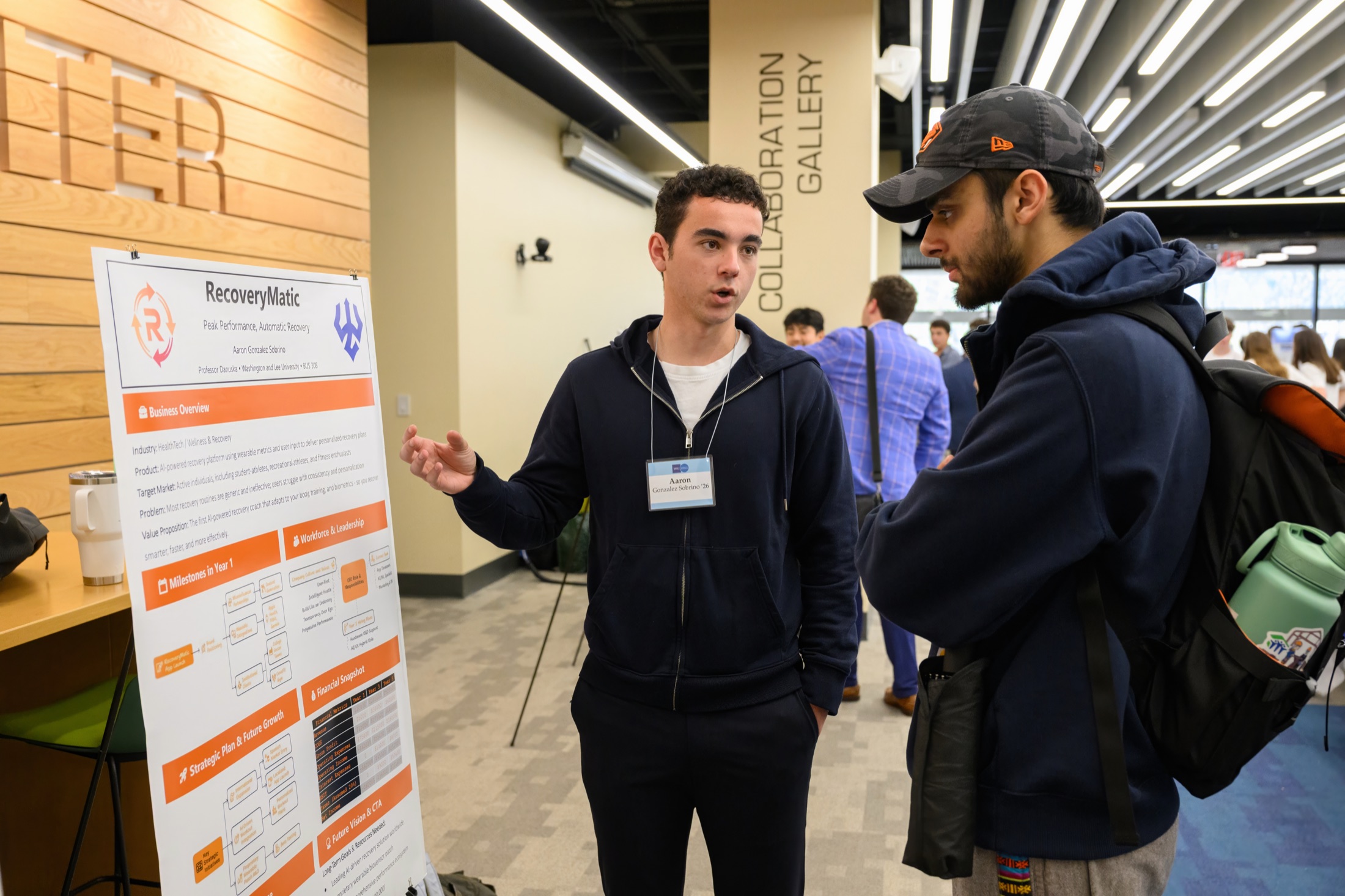
Where this ends up: showing a stranger what you built. Entrepreneurship Summit showcase, April 2025.
Wednesday, Sep 16
- Co-Intelligence, intro and ch. 1–3, read. Come knowing Mollick's four rules and which one today's skill obeyed or broke.
- Three inefficiencies, on paper. Five lines each: who, what the hands do, how often, how you know, bucket. One from a person you talked to. Every one names the organization. They go on the wall.
- Teams form. Two or three. You pick each other by the cards on the wall, not by who you sat next to.
If you built /card today, run your three through it tonight. If you built /digest, run the reading through it. Either way, bring what it produced.
What goes in Log 2 (1 of 2)
Week 2 · Sep 14–18 · Log 2 · Fri 11:59pm · 500–800 words · the form, not Canvas
| Field | This week, that means |
|---|---|
| Evidence | The gift, given: what they said when they got it, verbatim. Anyone you talked to for the hunt. Your team's running count starts at this number. |
| Experiments | Your skill on two real inputs, and the same input without it. What differed. |
| Key decisions | Named entry 2: the gift response and what it taught you about giving before asking. Which skill you built and why that job. Who your team is. |
| Assumptions tested | The design decision in your skill: what you thought the format needed, and whether the output agreed. |
| Harness change | The skill: its name, the one-sentence answer, the one line you changed and why, the classmate's name from the demo. |
What goes in Log 2 (2 of 2)
| Field | This week, that means |
|---|---|
| Touch-point status | None. Say so. You don't have a process owner yet. |
| Working / not working / differently | About the build, the demo, the gift, or the team you just joined. |
| Book connection | Co-Intelligence intro and ch. 1–3. One of the four rules, and one thing in your skill or your gift it explains. |
| AI audit trail | What you let the agent write in the skill file, what you wrote yourself, what you checked. |
Gift paragraph, skill sentence, classmate's name, four rules. If those four things are in the log, it passes. If they're vague, it comes back.
Coming up
- Tonight. Run your skill on the thing it was built for. Read Co-Intelligence.
- Wed Sep 16. Three inefficiencies on paper, on the wall. Four rules. Teams form.
- Fri Sep 18, 11:59pm. The gift, given. Log 2: gift response, skill, classmate's name.
- Mon Sep 21. Build day: your first hook. Something that fires without being asked, in front of a witness.
jaymargalus.com/foundations · the schedule shows this week and the next due date
Questions.
jaymargalus.com/foundations · jmargalus@wlu.edu · Holekamp 109 · Mon + Wed 1:45–2:30