Name your price.
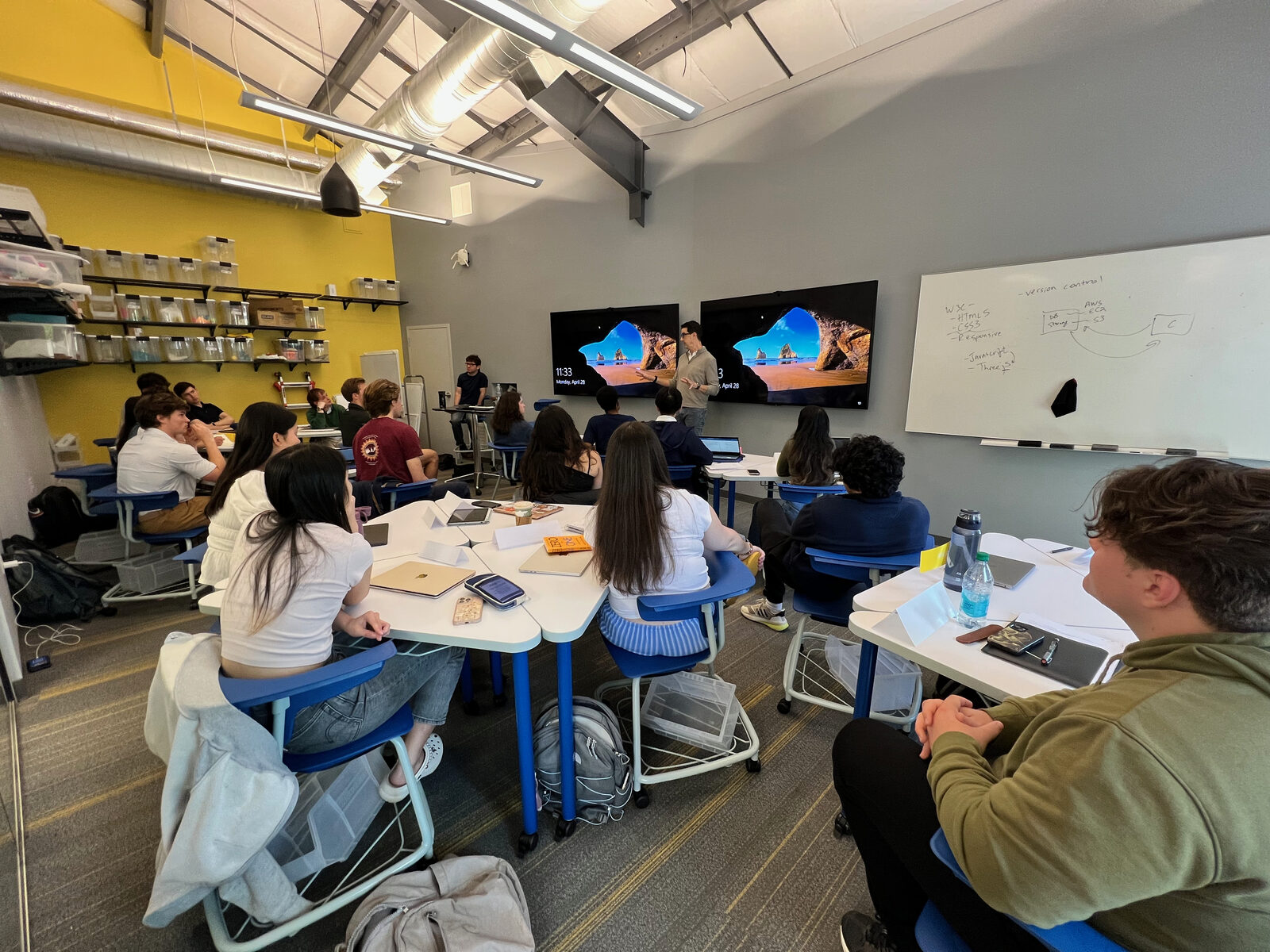
Jay Margalus · jaymargalus.com/foundations · DePaul students and Eugene Jarvis's cabinet, May 2022
| 2:45 | Two numbers, every team | 5 min |
| 2:50 | Minimalist Entrepreneur, ch. 3 | 8 min |
| 2:58 | Pricing, played: the vote, six businesses, floor and ceiling, the Pit | 38 min |
| 3:36 | Teams: leave it in a good place | 32 min |
| 4:08 | Log 5 and what's next | 7 min |
Today we play store.
Then we leave it in a good place.
- Every team, out loud: conversations so far (out of eight) and touch points running on sample inputs.
- The numbers go on the board and stay there all class.
Build as little as possible.
1 · By hand
Do the job yourself, for real people, before you write anything. If nobody wants it done by hand, they won't want it automated.2 · Write it down
Turn what you did into a process: the steps, the inputs, the judgment calls. Now someone else (or something else) could follow it.3 · Then automate
Only the steps that repeat and hurt. The product is the process with the boring parts taken out.- Small and shipped beats big and planned. Gumroad's first version was built in a weekend.
- Every feature is a guess. Leave it out until someone asks twice.
- That's your assignment in one line: one touch point, working, not the whole assistant.
Play store.
For the next 38 minutes, nothing you say is a promise to anybody. The prices are made up and the buyers are your classmates.
Play needs three things: low risk, rules everyone agrees to, and fast feedback. That's why we practice pricing here, before you try it on your contact.
You're subscribing to The Economist.
| A | Web only | $59 / yr |
| B | Print only | $125 / yr |
| C | Print + web | $125 / yr |
Count the hands. Write A / B / C on the board.
Same magazine. One option gone.
| A | Web only | $59 / yr |
| C | Print + web | $125 / yr |
Dan Ariely ran this on 100 MIT students. With the useless option: 16% A, 0% B, 84% C. Without it: 68% A, 32% C. Nobody bought B, and B still moved most of the room.
The lesson: buyers don't know what something is worth. They compare. So you decide what they compare you to.
One product, six businesses.
| Model | Who pays, when | It's betting that… |
|---|---|---|
| Subscription | The org, monthly, per seat or site | they'll use it forever |
| Per task | Per email sorted, per reminder sent | volume is real and countable |
| Done for you | A retainer; you run it | they want the problem gone, not software |
| Setup + upkeep | Big once, small after | every customer needs custom work |
| Cut of the win | A share of what it saves or recovers | you can measure the before |
| Nobody pays you | The org just spends less | the buyer is internal or a nonprofit |
Floor and ceiling.
Ceiling = hours saved per month × what an hour of that person costs
Floor = what it costs you to run per month: tokens + tools + your hours
Your price lives between them. If the floor is above the ceiling, no model saves the idea.
- Example · the banner shop
- 45 min/day × 22 days ≈ 16 hrs/mo
- × $25/hr owner time = $400 ceiling
- Floor
- ~$20 tokens + $0 tools + 2 hrs of you at $25 = $70
- Room to price
- $70–$400 / mo. Start near $150.
Use your contact's numbers if you have them. If you're guessing, write GUESS next to it. That guess goes in your ledger tonight as untested.
The Pit.
- I hand your team a buyer card. Keep it secret. Whoever stays at your table is now that buyer.
- Your sellers (one or two of you) pitch your own project to the next team up. You have 60 seconds: one model, one price from your worksheet, one sentence on why.
- The buyer gets two questions, then says deal, no deal, or makes one counteroffer.
- The buyer plays the card honestly, secret included, but only gives the secret up if the sellers ask the right question.
| Score | |
|---|---|
| +1 | Deal inside the buyer's budget |
| +1 | You asked who signs the check before you named a price |
| +1 | Deal at 2× your floor or better |
| −1 | Deal below your floor (you're paying them to work for them) |
Again, but smarter.
- I hand out new buyer cards.
- Sellers go one team down this time.
- Change one thing from round 1: the model, the price, or the question you ask first.
Buyers: last round, what made you say no? Tell your sellers before they leave.
Cross out four. Keep two.
| If you keep… | …then you have to bring back from your contact |
|---|---|
| Subscription | Proof they'll still use it in month 3 |
| Per task | How many: emails a week, reminders a month, orders a season |
| Done for you | Your hours. Can you actually run it every week? |
| Setup + upkeep | How different the next customer is from this one |
| Cut of the win | The before number. No baseline, no cut. |
| Nobody pays you | Whose budget gets smaller, and whether they care |
Write one sentence: "___ pays ___ because ___." It goes in the Business Case on Oct 16.
Leave it in a good place.
No class until Monday. Reading days are Thursday and Friday, and the Research pack is still due Friday night. Use this time so nobody's guessing what they owe over the weekend.
Before you leave the table
BY FRI OCT 9 · 11:59PM
- Research pack: count your conversations against eight. Name who closes the gap, and when.
- Observation hour: done or booked, with a date.
- Before numbers: who asks your contact, and by when.
- Who submits the PDF and raw notes.
BY MON OCT 12
- First working version runs on sample inputs.
- Your "who pays" sentence is in the ledger as untested.
- Read Minimalist ch. 4 for Wednesday.
- One question for the alumni panel (Wed Oct 14).
By Monday, who does what?
- Team
- Conversations / 8 · Observation hour: done / booked (date)
- Before number we're asking for · who asks · by when
- We keep these two pricing models
- Name → task → day (one line per person, absent teammates too)
What goes in Log 5
| Field | This week |
|---|---|
| Evidence this week | Your conversations (count + one quote) and the observation hour |
| Key decisions, and why | The two pricing models your team kept, and what killed the other four |
| Harness change | Memory: the ledger in your agent + your keep / forget lines from Monday |
| Touch-point status | Your first working version: what it ran on, what came out |
| Book connection | Minimalist ch. 3: the smallest thing your contact could use |
| AI audit trail | One thing your agent said that you checked, and what you found |
| Assumptions tested | Ledger statuses, including "___ pays ___" (untested) |
Coming up
- Thu–Fri Oct 8–9. Reading days. The Friday deadline stands.
- Fri Oct 9, 11:59pm. Research pack (team, Canvas) · Log 5 (you).
- Mon Oct 12. Second hook.
- Wed Oct 14. Try it with your contact. Alumni panel: red, yellow, green. Read Minimalist ch. 4.
- Fri Oct 16. Business Case, one page. Today's sentence is its first line.
Questions.
jaymargalus.com/foundations · jmargalus@wlu.edu · Holekamp 109 · Mon + Wed 1:45–2:30