Three minutes.
Jay Margalus · jaymargalus.com/foundations · Telepath Tactics on Kickstarter, December 2012: $18,615 of $25,500, funding unsuccessful
| 2:45 | Two numbers, every team | 4 min |
| 2:49 | Minimalist Entrepreneur, ch. 5 | 6 min |
| 2:55 | Place your bet: one game, two Kickstarters | 22 min |
| 3:17 | Cards Against Humanity, and your five lines | 12 min |
| 3:29 | The beats and the rules | 6 min |
| 3:35 | Storyboard your three minutes | 30 min |
| 4:05 | Swap and cut | 6 min |
| 4:11 | Log 9 and what's next | 4 min |
Prove it in three minutes.
That's the whole video.
- Every team, out loud: conversations so far and touch points running on real inputs.
- Numbers go on the board and stay there.
Market by being you.
Fans, not headlines
People don't care about companies. They care about people. Put yourself at the center of the story, even when it's uncomfortable.Build in public
Share what you learned and what you decided, struggle included. Give before you ask. "This is not about selling."Educate, inspire, entertain
Lavingia's order. Start with the useful thing you know and work outward.- Sales got you to a hundred. Marketing is sales at scale. Start with the free kind, which is your own story told by you.
- Your pitch video is this chapter in three minutes: you, on camera, saying what you did and what happened.
Place your bet.
One guy, one game, and two Kickstarters four months apart.
Watch ninety seconds. Then bet.
- Index card: FUNDED or NOT.
- One reason, ten words or fewer.
- Hands up for FUNDED. Three cards read out loud.
Goal: $25,500. Thirty-one days. He's already shipped six games.
▶ kickstarter.com/projects/1426761469/telepath-tactics · start at 0:30
$18,615 of $25,500.
840 backers. Funding unsuccessful.
He got to 73%, and on Kickstarter 73% pays out nothing. Nobody was charged.
Same couch, same shirt, same first ninety seconds.


He didn't reshoot anything. He cut three minutes out of it.
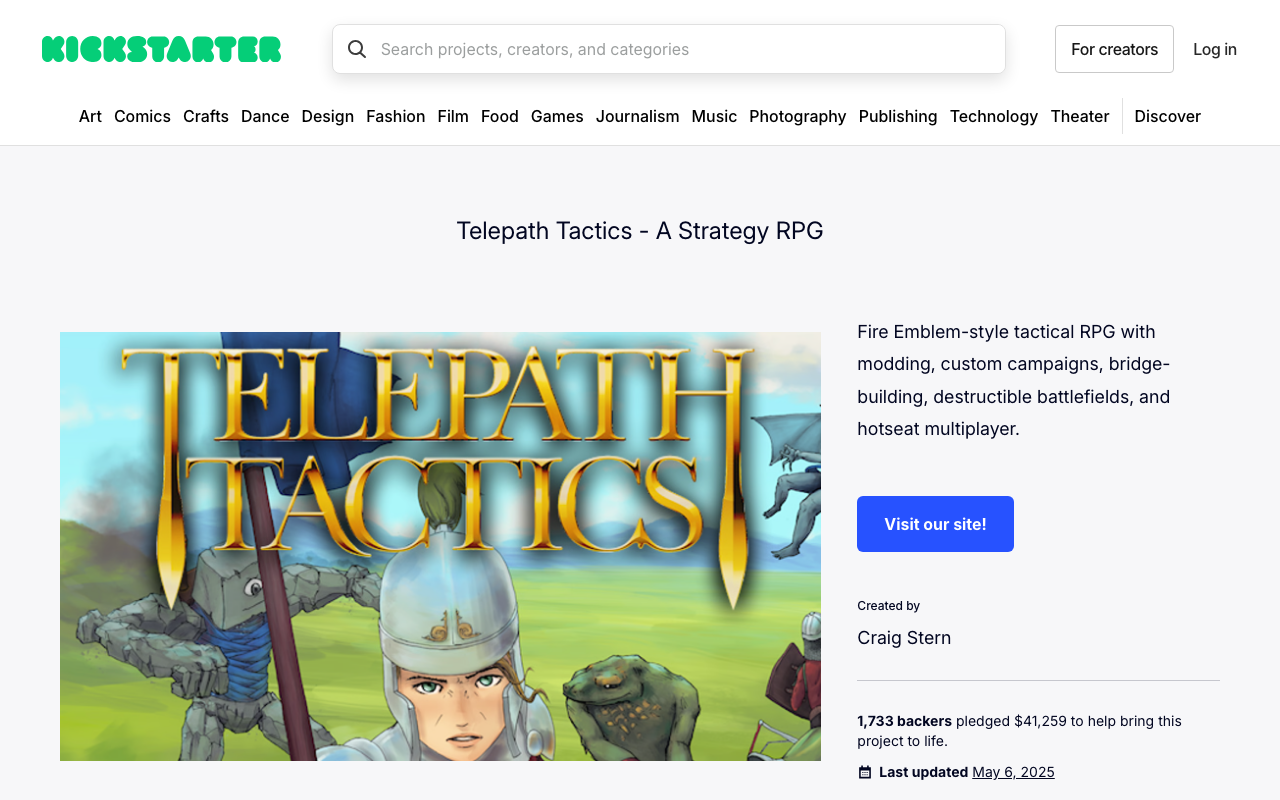
▶ kickstarter.com/projects/1426761469/telepath-tactics-a-strategy-rpg · start at 0:30
$41,259 of $15,000.
1,733 backers. 275% funded.
Same guy and the same game, with more than twice the money and twice the backers.
| December 2012 | March 2013 | |
|---|---|---|
| Video | 8 min 09 sec | 4 min 53 sec, same footage, 40% cut |
| Goal | $25,500 | $15,000, "only the bare essentials" |
| The money is for | Sound effects $12k · music $4k · art $4k · PAX East $2k · website $1k | Art and music. That's it. |
| Playable demo | Arrived late in the campaign | On the page from day one |
| Month | December. Final week was Christmas. | March |
| Updates · comments | 16 · 169 | 53 · 340 |
| Result | $18,615 · 840 backers | $41,259 · 1,733 backers |
He also emailed every one of the 840 who backed the first one. The second campaign hit its goal in days.
Gone
- The lonely-night-with-the-GameCube origin story
- Why sound effects cost twelve thousand dollars
- PAX East, the website, and "why should you fund promotion?"
- Reading the reward tiers out loud ("look over on your right")
- "If by some luck we get more money than that..."
Kept
- "Hey folks, I'm Craig Stern," then what the game is and how long he's been at it. Twenty seconds in.
- The feature list, over gameplay
- Why single-player needs more art and music
- One ask and a thank-you.
Kickstarter's own guide: "When you think you're done, take a break, then come back and cut out 25% of the video. YOU MUST." He cut 40.
"You are not going to convince anyone to back your game simply by filming yourself talking at the camera; your game is going to have to sell itself."
"Keep the pitch video short. Between 1 and 2 minutes is good... If your pitch video is longer than 5 minutes, it's way too long."
"Explain why you need the money... Just saying 'that's where you come in' doesn't cut it these days."
"Set the lowest possible funding goal that will get the game made."
Also on his list: lead with footage of the thing, have a demo from day one, and don't run it in December. Your video is due Nov 17 and Thanksgiving is the week after, so plan around it.
Cards Against Humanity.
December 2010. Eight friends. A $4,000 ask. 1 min 51 sec.
▶ kickstarter.com/projects/maxtemkin/cards-against-humanity
▶ youtube.com/watch?v=31laZEtdOqc · same video, their channel
$15,570 of $4,000. 758 backers.
- Twenty-six seconds in, you've met all eight of them. "I'm Ben and I'm one of the creators." Couch, phone camera, done.
- One line says what it is. "A party game for horrible people." Then they stop describing and play a round on camera.
- The pitch makes the same joke the game makes. By the end you know exactly what you'd be buying.
- The ask is plain. "Order the game and work with us to get these first copies made." The number is on the page: $4,000 for the first printing, $15 a deck.
- It's 1:51. It ends on a blooper. "My hand was covering the microphone." They left it in.
A phone on a couch was enough. They told you who they are, played the game, and asked for $4,000. Kickstarter's guide, 2009: sound "is actually even more important than the image."
Your pitch in five lines.
- Who we are, and who we built this for.
- The job, in your contact's words.
- What you built, doing the job on something real from the business.
- What changed. The number before, the number after, and what your contact said.
- The ask. One number and what it buys.
One line each, on one card. Two teams read theirs out loud. A blank line is your work for this week.
Kickstarter's list, and yours.
| Kickstarter, 2011 | Your video, due Tue Nov 17 · three minutes max |
|---|---|
| Introduce yourself | Every teammate on camera. Names, who your partner business is. |
| Tell your story | The problem, in your contact's words if you can get them. |
| Show the thing | The assistant running, on real information, on screen. |
| Ask, and explain why | The evidence: before numbers, what changed, what your contact said. |
| Say what they get | The other ten: who else would pay, and why. |
| Say thank you | What you're asking for. Then thank them. |
Left column: Kickstarter's "Tips for Making Your Project Video," June 2011. Right column: the checklist on the deliverables page. They line up almost one to one.
| Rule | Where it comes from |
|---|---|
| Who, what, and for whom in the first twenty seconds. | Kickstarter's video guide, 2009 |
| Show the thing running instead of describing it. | Craig's step 3; the CAH video |
| One number in the ask, and what it buys. | Craig's step 6; CAH's $4,000 |
| Cut 25% after you think you're done. | Kickstarter's guide. Craig cut 40. |
| Light and sound beat the camera. Daylight, a quiet room, the mic close. | Kickstarter's guide |
| Be yourself on camera. Nobody's grading production value. | Kickstarter, 2011; Lavingia, ch. 5 |
| Three minutes max. Every teammate on camera. I'd aim for 2:30, but that's advice. | The checklist |
Storyboard your three minutes.
- Six boxes on paper, thirty seconds each.
- In every box: what's on screen · who's talking · the one line they say.
- Box 1 is the first twenty seconds: who you are, the job, the person it's for.
- Box 3 or 4 is the assistant running on a real input. Decide now what you'll record and when.
- The last box is the ask, the number, and thank you.
Write who shoots what on the back. Photograph the board before you leave. You'll want it when you shoot.
Swap and cut.
- Trade boards with the team next to you.
- Mark the 25% you'd cut. Circle it.
- Write the one beat that's missing in the margin.
- Hand it back. Write down what they said instead of arguing with it.
Craig needed 840 strangers to tell him what to cut. You get a team and six minutes.
Coming up.
- Wed Nov 4. Read Minimalist ch. 5 before class.
- Fri Nov 6, 11:59pm. Log 9, Google Form. Same fields as always.
- Wed Nov 11. Read Minimalist ch. 6–7 before class.
- Fri Nov 13, 11:59pm. Log 10, and Book memo 2 on Canvas.
- Tue Nov 17, 11:59pm. Pitch video on Canvas, one per team, three minutes max.
- Thu Nov 19 · Video Pitch Competition. Required, and it counts as a class day. Judged by alumni from the Connolly Center board.
Questions.
jaymargalus.com/foundations · jmargalus@wlu.edu · Holekamp 109 · Mon + Wed 1:45–2:30