
A quieter week on the surface, but the kind where the ideas pile up in unexpected corners like code windows, student conversations, half-built hardware, grant documents, and browser prototypes that refuse to behave neatly.
Building Strange Things on Jetstream2
I spent time exploring Indiana University’s Jetstream2 and realized the real opportunity isn’t just “run a big model faster,” but to use the compute to prototype genuinely weird systems. The Plankton Network idea won the week — a distributed sensor-mesh that treats the ocean more like a living computation than a dataset. A close second: continuing some of the microscopy work that I did a while back, but pointing the device at other big (but small) problems that data can help with.
There’s this thing I do when encountering new tech where, instead of driving straight toward a solution to something, I play with it a bit first. That’s where we’re at with this — a toy eventually becomes an understanding, which leads to an insight.
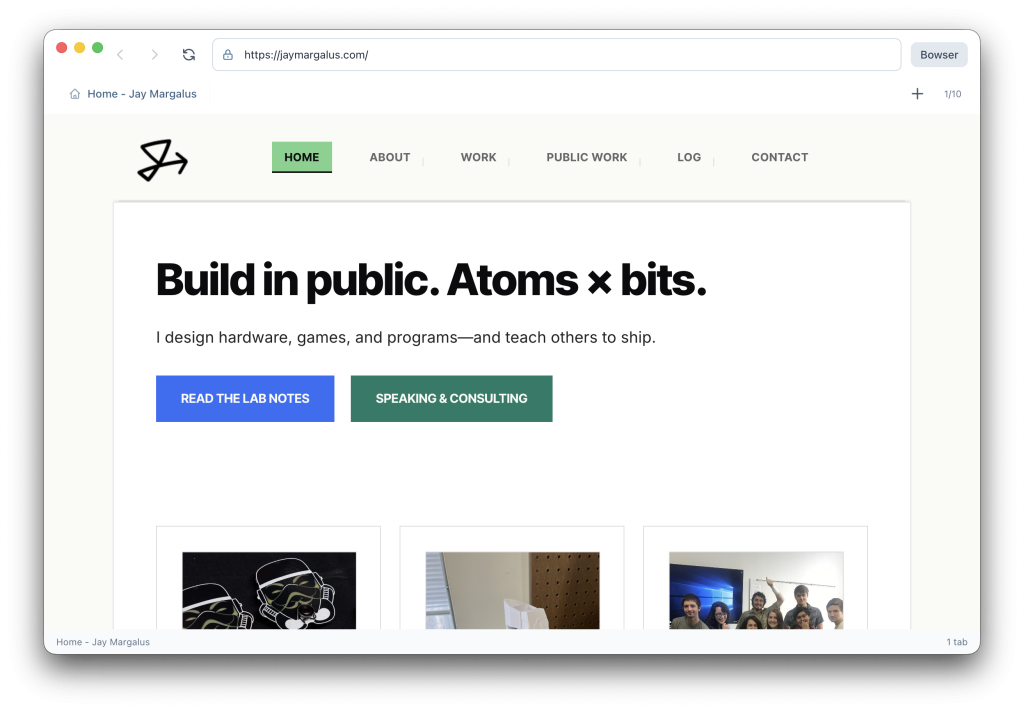
Bowser: My Slow Internet Browser Moves Toward 0.2
My RSS reader-browser-hybrid (“Bowser”) continued evolving toward the thing I actually want: a browser that unclutters my brain instead of fracturing it. I worked on integrating something in the spirit of StumbleUpon — not the gamified version from 2007, but the quiet serendipity beneath it. A “give me something delightful but not algorithmically thirsty” button.
This might become a defining feature: a machine that nudges me sideways rather than down.
ourss Digest Re-Prompting
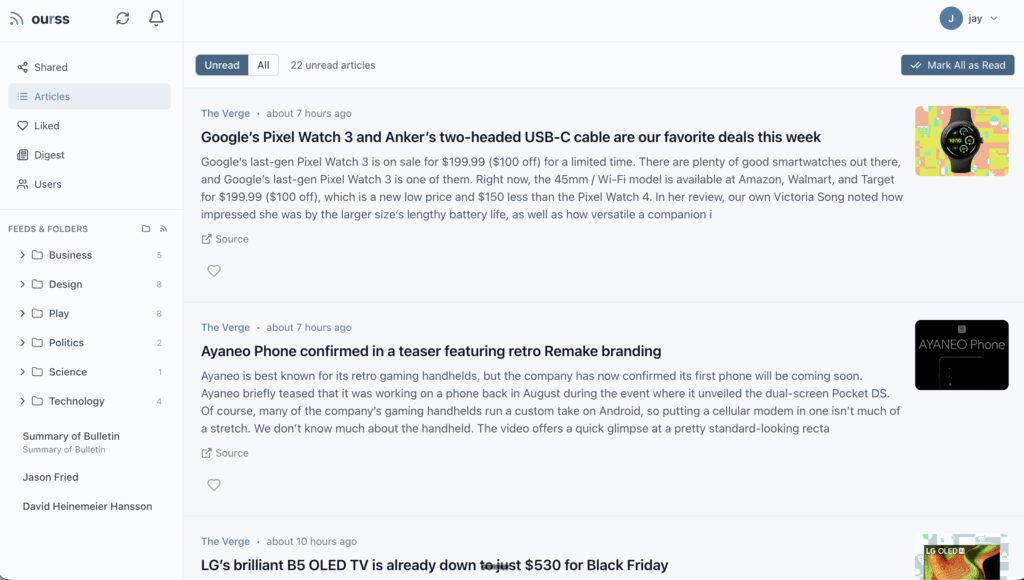
I’ve been tuning the prompt system for ourss so that the digests feel like something a human actually noticed rather than something that simply happened to pass through an API. The goal isn’t summarization; it’s texture. Giving people the sense of what was alive in their feed that week. Not personalization to me, but personalization to whoever’s using it. Harder than it sounds.
On Being an Artist Versus Running an Art Business
The long essay in the reading digest about making a living as an artist is a pretty good read. The author describes the work of earning a living with your art as strengthening a muscle — not just the creative muscle, but the operational one: pricing, shipping, talking to collectors, iterating on what resonates, learning Image-Market Fit by trial. The part I underlined:
“Business is simply a lens. It’s a set of knobs that help you understand how money is made and spent.”
That idea. The notion that every creative practice is just a different arrangement of the same knobs — is exactly how I teach entrepreneurship. It’s satisfying to see it articulated so directly.
Doctorow on Risk-Shifting and “Flexible Labor”
Cory Doctorow’s piece on so-called “flexible labor” was another standout. He reframes the gig economy not as flexibility but as risk displacement — capital off-loading its operational uncertainty onto workers, one cleverly-named contract clause at a time.
That analysis is relevant to almost everything I teach students about power, systems, and what actually happens underneath business models. The more I read Doctorow, the more convinced I am that entrepreneurship students need a required systems-literacy course — a “here is how power is engineered into the infrastructure of markets.”
Space Apps, Badges, and the Ongoing Fourfold Push
I spent a little time this week refining a Cardano proposal with my guys at Fourfold. Every time I return to the THOTCON 0xD badge work, I’m reminded how much latent potential physical computing still has. We’ve barely scratched the surface of using hardware as onboarding — not gimmicks, but real worlds you can touch.
This week’s idea: a badge-to-blockchain bridge that treats the machine like a physical wallet. It’s strange enough that it might work.
Students, Schedules, and the Quiet Parts of Teaching
A lot of my week was spent smoothing things out for students… scheduling mentor visits, rewriting instructions so they make sense at 8:05 a.m., and keeping projects moving without killing the parts of the class that make it fun. We’re deep in the season where students are stretched thin and the work becomes less about content and more about creating enough clarity for them to move forward confidently.
A Final Thought: Adjacent Familiarity
The “adjacent familiar” concept from the art essay is a thing we teach in design — the idea that once someone loves a certain form, they want variations that sit just to the side of what they already know. It’s true of art, of games, of hardware, of teaching, and of programs like the one we’re building at W&L.
Everything new we’re building — Bowser, ourss, the AI models, the Cardano badge system — is really just adjacent familiar to something I’ve been circling for years: tools that restore human agency by stripping away unnecessary complexity.
A good reminder for the week ahead.
>> Oh, and check out my student MG’s new book on Amazon.
What a fantastically wonderful time this all is.