Show
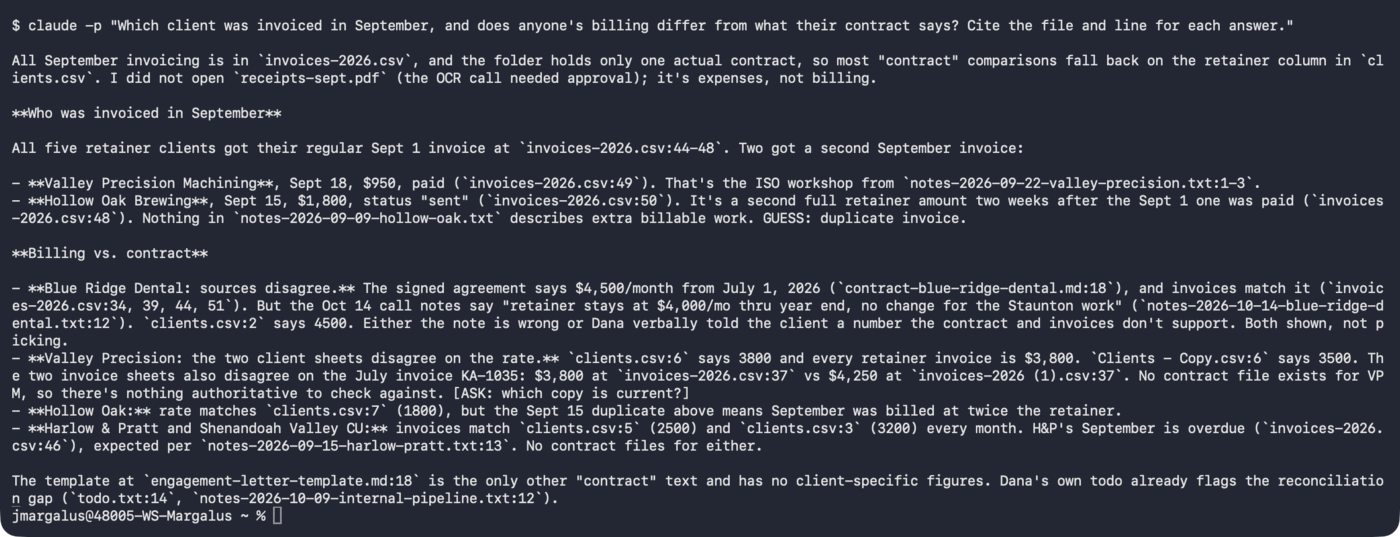
One prompt against thirty files I never opened. It answered a question I could check by hand and told me where it looked. The files stayed on my disk. What it read went to Anthropic to be reasoned about, so only point it at things you'd paste into a chat window.
Why Claude Code. The chat window makes you carry your work to the model, one paste at a time. Claude Code brings the model to your work: it sees the folder, runs commands, edits files, and asks first. One tool, learned deeply. Figma was that tool in my classes a decade ago.
Do 0 of 9
Get access. Students in my courses: accept the invitation to my Anthropic Console org (by email, role “Claude Code”). Everyone else: a Claude plan. Pro to start, Max if you'll do Projects 3 to 5.
Install. Open Terminal (Mac: Spotlight, type Terminal; Windows: Git Bash) and follow the install page. Type
claudeand sign in when it asks. Console-org students sign in with the Console account.Get the practice folder. Download the workshop kit, unzip it, open the
practicefolder. A made-up consulting firm with a dozen planted problems. Fake data. Your own files come later.Start it in that folder. In the terminal:
cd, a space, drag the folder onto the window, Enter. Thenclaude. Read the first permission prompt out loud.Ask it to look around.
What's in this folder? One line per file. Flag anything that looks like a duplicate or a draft.
Did it find the two client CSVs that disagree? The “Copy of” file?
Ask four questions it can only answer by reading.
One at a time. Demand sources.
Which client was invoiced in September? Cite the file and line.
Does anyone's billing differ from their contract? Cite both.
Is there an email here that never got a reply? Which one?
What's happening next week, according to these files?
Check one by hand. Open the file it cited. Is the line there? Does it say that? Expect at least one of the four to be wrong or thin. Finding it is the point.
Correct it by talking.
That's not what line 14 says. Read it again and tell me what you got wrong.
Describe, watch, check, redirect. That's the loop you'll live in.
Make one thing.
Write a one-page summary of this firm as summary.md: clients, what each pays, open problems. A source line under every claim.
Open the file. A document with receipts.
Ticks are saved in this browser.
Check
- Four answers, each with a file and line, and you opened one cited file and confirmed it.
- You caught one wrong or thin answer and got it fixed without typing the right answer yourself.
summary.mdexists and you can find the source of any sentence in under a minute.- Bonus: ask it today's date with no tools. Then ask it to run
date. Idea 06, live.
In your course
Assign
This project on a folder from your field with three planted errors you keep a key for. A clinic's intake forms, a case file, a lab notebook. Thirty files is plenty.
Grade
What they caught, what the agent caught, what both missed, with the transcript. Not the summary. The summary is the agent's. The catch list is theirs.
Watch for
Students who accept the first answer. The one who argues with it has learned the course.
The whole term's plan is on the faculty guide.