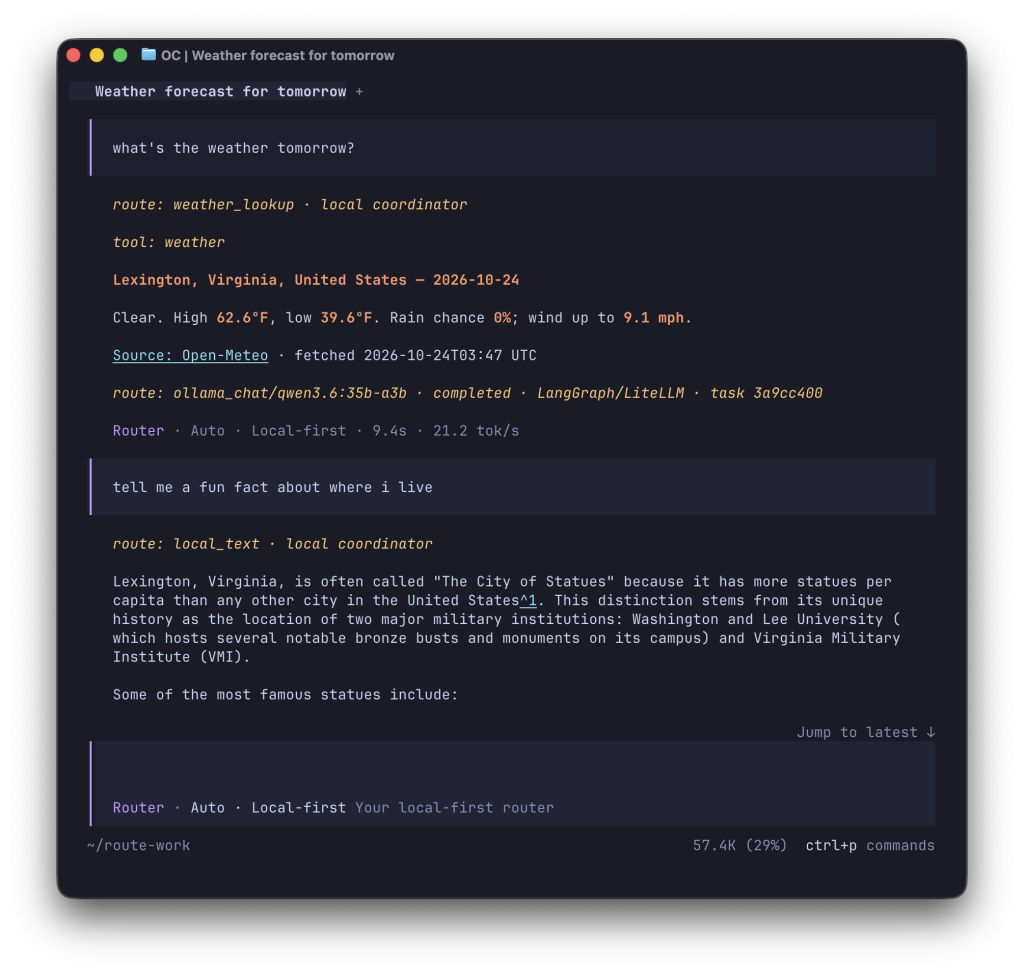
The screenshot above is my computer answering “what’s the weather tomorrow?” A small model on the machine read the question, decided it was a weather lookup, called a free API, and handed the result to a local 35B model to write up. Nine seconds, no API key, and the question never left the house. The fun fact that follows went the same way, and it’s partly wrong (Washington and Lee is not a military institution, whatever the model thinks), which is about what a free answer is worth today.
My thesis is that models become commodities, and that most of what people ask a model will soon run on hardware they already own.
This is first-principles stuff. Computers get faster. As they get faster, the model that needed a data center two years ago runs on a laptop, and the one that needed a laptop runs on a phone. Nothing about that curve requires a breakthrough. It’s the next few years of chip releases. And while the hardware catches up from below, post-training and harnesses push down from above. A mid-sized model wrapped in a decent tool loop does a surprising share of what a frontier model did bare a year earlier. The gap between “good enough” and “the best” keeps shrinking for ordinary questions, and ordinary questions are most of the questions.
So picture the stack a few years out. A router — itself a small model — sits on the machine and sorts every query by weight. The weather, a draft email, a simple website, “what did I say in that meeting” all stay local and come back fast. Harder jobs go to a cheap remote model. Only a sliver escalates to the frontier: research, medicine, defense, the work where the last few points of capability are worth real money. Most people will never know which tier answered them, the same way nobody knows which CDN served the image on this page.
The frontier models don’t go away in this picture. They get specialized. They become the thing you call for the hard problem, which is a smaller business than being the thing everyone calls for everything.
What changes next, I’m less sure about. But I have a few guesses.
First, in the near term, people buy more computer than they think they need. The super-users go first (the setup in the screenshot is one of them), then it trickles down the way every capability does, until a decent local model is a line on the spec sheet next to the storage.
Second, once a model is close to free, people use it for everything. It stops being a destination you open and becomes a thing embedded in every task, the way spellcheck is. Nobody says “I used AI to fix the typo.”
Third, and this is the part institutions are slowest on, none of it is optional. When the model ships in the computer, it’s part of how work gets done. In academia that means the debate about whether students use it ends by default. They do, offline, with no account to audit. In the corporate world it means IT loses control over which models employees run, at least for a while, because the model is just a process on the laptop like any other.
We won’t call it AI by then. It’ll just be the computer.