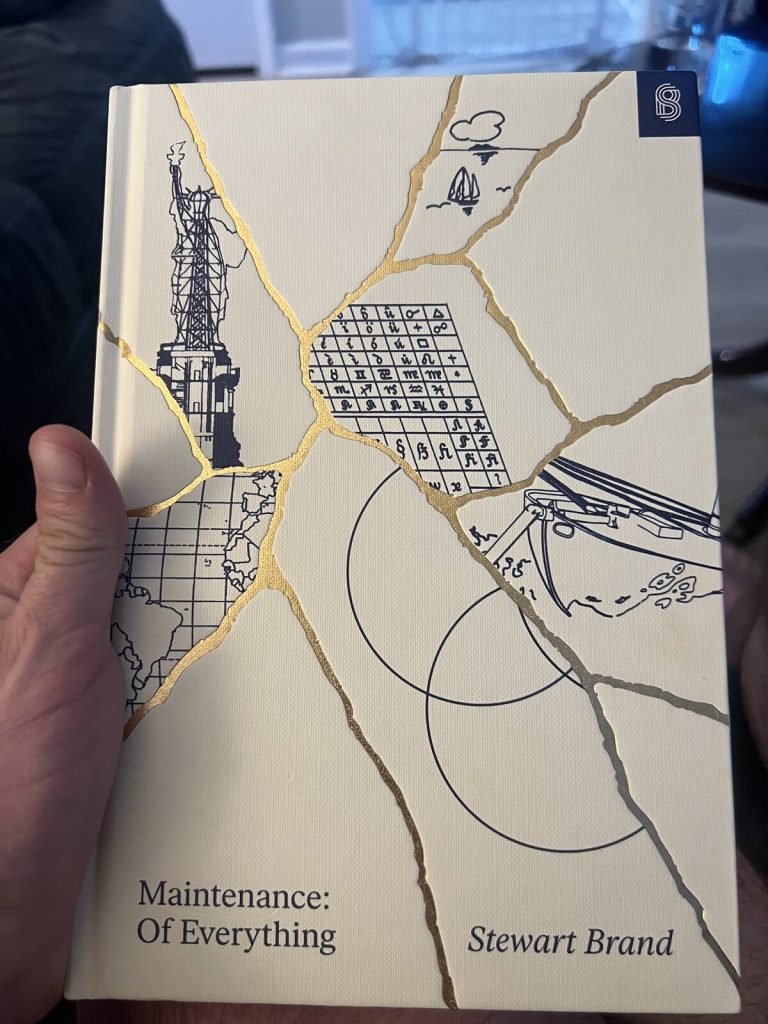
The book above is Stewart Brand’s Maintenance: Of Everything. It’s been on my mind because of a run of security notices, first nginx and then the Java runtime. I texted a good friend who deals with this for a living to ask what was going on, and his answer was that his team was exhausted.
Why it’s happening isn’t complicated. The same models that made code cheap to write made the holes in it cheap to find. An attack costs almost nothing now, and the defense costs what it always did (a tired person and a patch). There was never going to be 100% security, but the pace is new.
So software got cheaper to make and more expensive to maintain, at the same time.
The value shifts to maintenance.
That’s a strange thing to say about software, where the money and the credit have always gone to whoever shipped the new thing. Brand’s whole book is about the unglamorous work of keeping things going, and for most of software’s history you could skip that work and survive. I don’t think you can anymore. If anyone can make the thing and anyone can break it, the scarce person is the one who keeps it running.
The trouble is where the breaking happens. The notices are for the open source projects underneath everybody’s product, and open source has never been paid for the way it’s used. Companies mostly take. Once in a while they hire a maintainer or kick a little funding over. For the people running the big projects, keeping up is a huge burden with very little reward.
I asked my agent for a precedent, and the best one it found was fire in 19th-century Chicago. Balloon framing made wooden buildings fast and cheap, so the city went up in wood. Your neighbor’s cheap building was your risk, and nobody owned the risk between buildings. The ones who finally paid were the insurers, since they had the most to lose. They funded Underwriters Laboratories (Chicago, 1894) and wrote the country’s first model building code.
Fire doesn’t adapt, though, and an attacker with a model does. The closer fit is piracy, which never ended. It settled into a standing cost, carried by whichever navy had the most trade at stake, plus marine insurance. I started out asking how this ends. It doesn’t end, I think, it turns into a line item.
My guess is that open source splits into hobby projects and maintained ones, and that the maintained ones get paid for the way fire safety did, by whoever has the most to lose. Sooner or later an insurer won’t write your policy until you’ve audited your dependencies.
What worries me is that this is a problem for collective action, and it’s arriving at the exact moment we’re atomized. I hate the idea that insurance is the thing that saves us. My bet’s on it anyway.