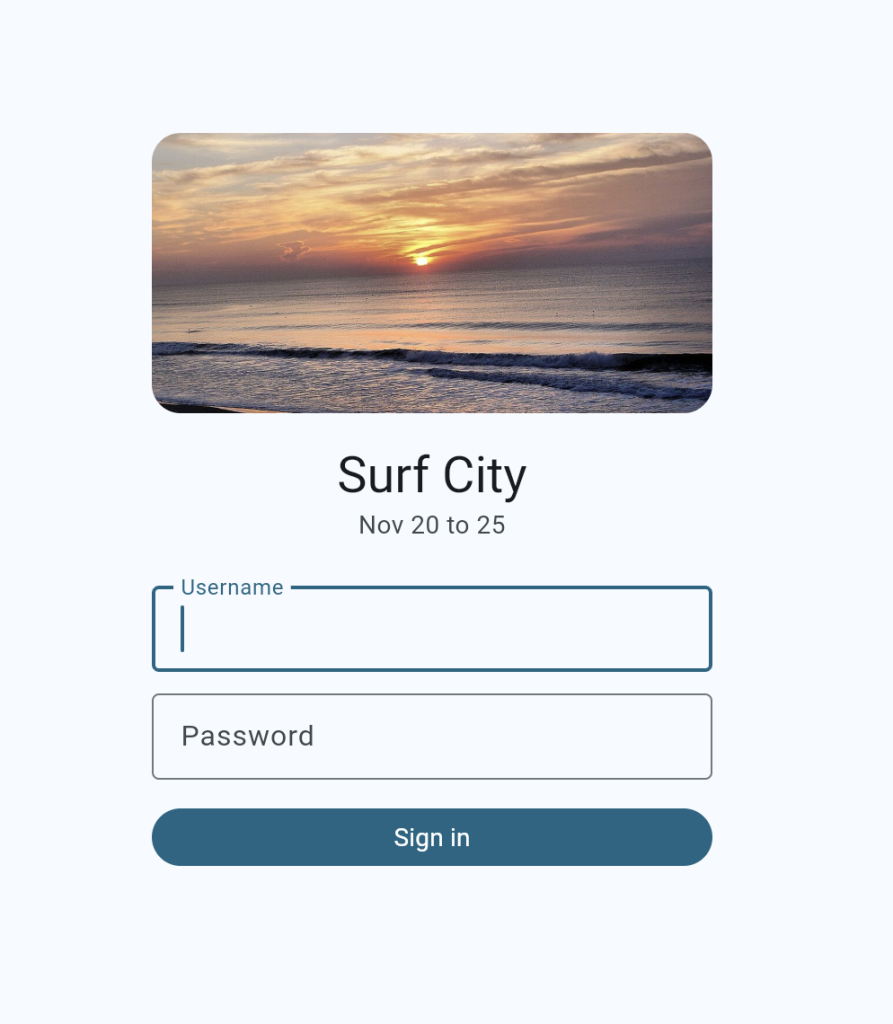
The screenshot above is the login page for an app that will exist for about six days. My wife and I are going to Surf City for Thanksgiving week. We wanted a way to plan the days together, bookmark places, leave each other notes, and have it on our phones while we’re there. Normally you’d go find an app for that, make accounts, and live with whatever it decided a trip looks like.
Instead I described what we wanted to my agent, out loud, through a dictation tool running on my laptop. Ten minutes later there was a phone app at a URL on my website. It already knew about the Airbnb, our dates, how many kids we have, that we’re bringing an older dog, and what I like things to look like. It texted us each a login. When the trip’s over it goes away, and the next trip gets a different one, shaped around that trip.
Nothing about it is impressive as software. That’s the point.
Here’s what happened under the hood. I talked to my computer. A small model on the machine read the request and decided how heavy it was. The agent picked a model for the job, pulled in what it already knew about me, built the thing, put it live, and sent the texts. I didn’t open a chatbot or pick a model. I said what I wanted and went back to what I was doing.
Most people won’t think of these as agents at all, and it helps to separate two things that get lumped together. The model is the part that thinks. The agent is the layer around it that holds your preferences, your rules, your memory, and your tools, and that decides which model to call for which task. Human intent goes in, the agent routes it to models and tools, and action comes out. As the agent accumulates knowledge about you, it gets more useful. The model underneath becomes interchangeable. I’ve swapped mine several times this year without touching anything else.
This already works this way for people ahead of the curve. It’ll look like the future to everyone else until it’s a layer in the operating system instead of a terminal on a laptop.
Now the part I’m less sure about. If intelligence is cheap, and so is the software that organizes it, then software becomes disposable. The cost of making a purpose-built tool for a six-day event just dropped below the cost of adapting to someone else’s. Why bend your behavior to fit an app when your agent can generate the interface and the workflow you need on demand? When that’s true for everyone, the app store stops being the default answer.
The hedge is maintenance. Disposable is fine when the trip app goes away on schedule. The trouble starts when it turns out to be useful and you want it next year, or when the thing you generated in ten minutes is now something your family or your business depends on. Nobody has solved that yet. I’ve lived it. This summer I had to strip my home server back to a short list of things it’s allowed to run, because the generated stuff had sprawled past what I could keep in my head. Stewart Brand has a great book on maintenance that just came out, and it’s worth reading with this in mind.
Still, the direction is clear. DHH is building toward what he calls a malleable computer, where the agent can modify not just the applications but the operating system itself. Instead of adapting yourself to the software, you adapt the software to you. Our trip app is a small, silly version of that, and I’ll delete it the Monday after Thanksgiving.